• Hey Guest. Check out your NeoGAF Wrapped 2025 results here!

Cerny confirms PSSR2 and FSR4.1 use same neural network


If SteamDeck can, I'm sure XSX is able too.

I think it's not too late for MS to make a move.


Microsoft has basically discontinued Xbox Series consoles anyway.....

So it's a moot point


I can only imagine the performance level of FSR4 on a SteamDeck....

LOL
 
Last edited:
Microsoft has basically discontinued Xbox Series consoles anyway.....

So it's a moot point


I can only imagine the performance level of FSR4 on a SteamDeck....

LOL

I am playing games on Steam Deck with FSR4 🤷

also they wouldn't even need to do anything, just talk to AMD to allow their unreleased int8 version to be actually used by developers... I mean fuck, they could probably add a system wide toggle to override FSR2/3 lol, but that would need to come with a perfomance warning of course.
 
The point of an upscaler is usually to render less pixels to get a performance boost with "like-native" quality

If you don't get the boost and the performance is the same of the native resolution you are trying to decrease, the purpose of the ML upscaling is lost completely
 
Last edited:
Microsoft has basically discontinued Xbox Series consoles anyway.....

So it's a moot point


I can only imagine the performance level of FSR4 on a SteamDeck....

LOL
It sounds counterintuitive, but it's actually good because it's on a handheld. You don't use system frame rate v-sync, then cap at 30fps and FG to 60fps. Looks and plays much better. FSR4 on Deck looks better than tiny DLSS on Switch from my experience and the motion clarity is better when comparing Cyberpunk(I have it on SW2 and Deck).
 
I can only imagine the performance level of FSR4 on a SteamDeck....


In case you missed it, the video displays FPS counter on top left corner. It's about 15% performance loss when compared to FSR3, but it's well worth the cost.

And XSS desperately needs this kind of treatment especially with Switch 2 beating XSS in every new releases with its dumbed down DLSS.

This is not just about the profit, the xbox brand as whole is just becoming a laughing stock these days.
 
Last edited:
I don't know if they can override a temporal upscaler with a ML upscaler at system level...

Otherwise Sony would have done it for Decima Engine's "PICO" to PSSR 2
 
Last edited:
I don't know if they can override a temporal upscaler with a ML upscaler at system level...

Otherwise Sony would have done it for Decima Engine "PICO" to PSSR 2

It can be done. AMD did it with FSR3.1 to FSR4.
And Optiscaler can read the inputs from DLSS, FSR or XeSS and give them back to any other upscaler. Though it does it by hijacking a direct3d dll.
PICO is very likely to use the same inputs as other upscalers, motion vectors, color, jitter samples and depth buffers. So it could be "hacked".
But it would be just easier to integrate PSSR2 into the game, as work of exposing the motion vectors, color and depth buffers, is already done.
 
Last edited:
It can be done. AMD did it with FSR3.1 to FSR4.
And Optiscaler can read the inputs from DLSS, FSR or XeSS and give them back to any other upscaler. Though it does it by hijacking a direct3d dll.
PICO is very likely to use the same inputs as other upscalers, motion vectors, color and depth buffers. So it could be "hacked".
But it would be just easier to integrate PSSR2 into the game, as work of exposing the motion vectors, color and depth buffers, is already done.

Yeah doesn't make sense it to "force" this, when they could basically ask Guerrilla to do it

Sony literally owns the developer
 
I don't know if they can override a temporal upscaler with a ML upscaler at system level...

Otherwise Sony would have done it for Decima Engine's "PICO" to PSSR 2

people replaced FSR2 with DLSS in Starfield on day 1, and it worked perfectly.

that was during the time where there was this whole controversy with AMD sponsored games launching without DLSS for no good reason.
 
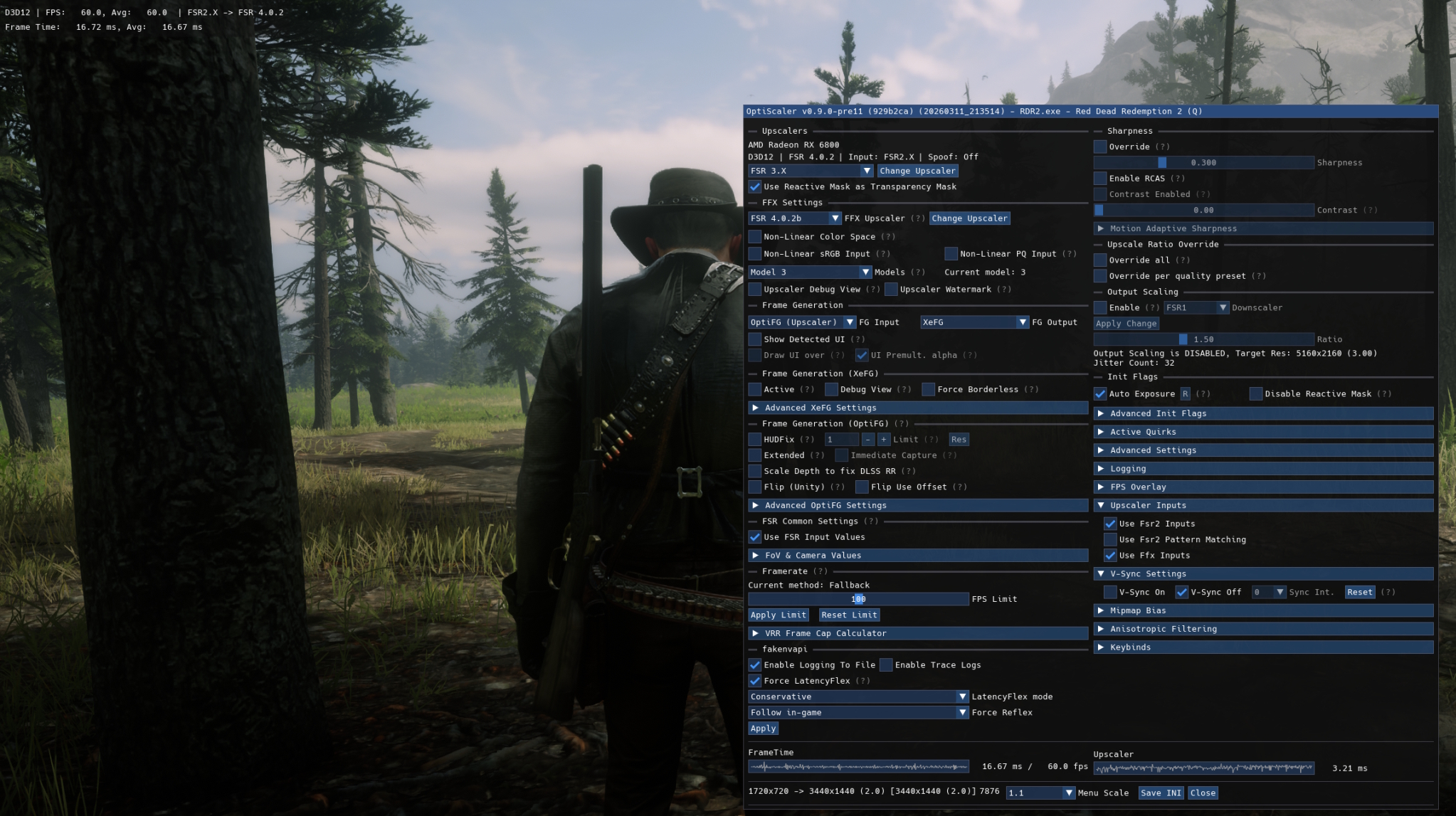
BTW, with the new modded FSR4.0.2b, 3.21ms on a RX 6800. Not bad for an RDNA2 GPU running on DP4A

bqKTd2F2PWNHYu2t.jpg
 
ah, didn't notice that.

not sure what PSSR costs from 720p to 1440p tho 🤔 would be interesting to know
With upscalers... PSSR is pretty much fixed. I mean you are looking at a swing of no more than 0.3ms between resolutions. And what really determines the cost of the upscale is the input rez. Going from 720p to 4K takes less time than going from 1440p to 4K. That's because the Ai has fewer input pixels to analyse.
 
With upscalers... PSSR is pretty much fixed. I mean you are looking at a swing of no more than 0.3ms between resolutions. And what really determines the cost of the upscale is the input rez. Going from 720p to 4K takes less time than going from 1440p to 4K. That's because the Ai has fewer input pixels to analyse.

render time increases with the target tho. 720p to 1440p doesn't take as much time as 720p to 2160p.

most PSSR games target 4k afaik.
most games that were testable showed a bit more than 2ms of render time cost I think
 
Last edited:
render time increases with the target tho. 720p to 1440p doesn't take as much time as 720p to 2160p.

most PSSR games target 4k afaik.
most games that were testable showed a bit more than 2ms of render time cost I think
While that is true... kinda, its somewhat irrelevant.

The Actual time the AI spends processing the data is fixed. At 1.85ms. Then, depending on output rez, can take anywhere form 0.15 - 0.25ms to write that to the screen.
 
While that is true... kinda, its somewhat irrelevant.

The Actual time the AI spends processing the data is fixed. At 1.85ms. Then, depending on output rez, can take anywhere form 0.15 - 0.25ms to write that to the screen.

I have seen very big performance drops when using DLSS up to 4k instead of targeting 1440p, even with the same input resolution.

I doubt that's different with PSSR.
but that also I guess depends on which part of the image are rendered at native resolution.

if done "properly" with DLSS, all the post processing happens only after the initial reconstruction... and post processing at 4k will have a far higher performance impact than post processing at 1440p. especially when heavier stuff like DOF is part of a scene
 
Last edited:
This is false. They started in 2023.

"There are really two goals, one shorter term and one longer term," explains Cerny. "The shorter-term goal is to co-develop neural network architectures and training strategies for game graphics. We're stronger together than apart, so it makes a lot of sense to combine some of our resources when tackling these problems. And because we began this collaboration in earnest in late 2023 (when PSSR development was wrapping up), I'm happy to say that there have already been results.

FSR4.0 is part of that collab.
Timeline is: 2022 Sony begins work on custom ML for Viola and PSSR -> 2023 AMD does their ML HW for RDNA4 and begins work in FSR4 (including the leaked INT8 version which was abandoned in 2023) -> Late 2023 AMD and Sony realize working separately is stupid and begin the Project Amethyst collaboration -> 2024 Sony finishes PSSR mostly on their own but some stuff from PSSR is incorporated in FSR4 -> 2025 PSSR2/FSR4.1 joint development

I believe the reason FSR4.0 never made it to PS5 Pro is because AMD's own ML tools are only built for their architectures (RDNA3/4, CDNA1/2/3/4/5), so porting FSR4.0 to PS5 Pro would be a lot of manual work and since it had some issues, it made sense to just skip to the next version.
 
Timeline is: 2022 Sony begins work on custom ML for Viola and PSSR -> 2023 AMD does their ML HW for RDNA4 and begins work in FSR4 (including the leaked INT8 version which was abandoned in 2023) -> Late 2023 AMD and Sony realize working separately is stupid and begin the Project Amethyst collaboration -> 2024 Sony finishes PSSR mostly on their own but some stuff from PSSR is incorporated in FSR4 -> 2025 PSSR2/FSR4.1 joint development

I believe the reason FSR4.0 never made it to PS5 Pro is because AMD's own ML tools are only built for their architectures (RDNA3/4, CDNA1/2/3/4/5), so porting FSR4.0 to PS5 Pro would be a lot of manual work and since it had some issues, it made sense to just skip to the next version.

A very interesting insight, so the INT8 version of FSR4 was not some dumbed down version of FP8 FSR4, instead it was the prototype of FSR4. This explains why it took so long for them to port it over to PSSR, also not releasing on RDNA2/3 cards.
 
Last edited:
M MazingerDUDE It wasn't a prototype of FSR4, training for FSR4 would have been done at FP32 full precision or FP16 ironically on Nvidia hardware most likely, you train a model and that produces the models weights, but to do that you have to compute gradients, tiny incrementral adjustments over millions of iterations via back propogation.

Once your model is trained you can then freeze the weights and you can then quantize them down to FP8 or INT8, you're no longer computing those gradients you're just doing forward passes of them, you lose a bit of quality but gain a huge amount in terms of speed and efficiency.

When Cerny says it's the same neural network, he means it's the same, the quant is different, for RDNA4 on PC it will be FP8 because you have the 3rd Generation Matrix Acceleration Engine on the GPU's they can do FP8 and BF8 and on PS5 Pro you have INT8 support because it's more efficient per watt and uses less die space, but will have trouble running larger models as each weight and activation has to snap to a specific value say 43, it couldn't be 42.7.

The reason it's notr releasing on RDNA2/3 cards is the lack of ML Compute available on them, even the 7900XTX only has 123TOPS of ML Compute, the PS5 Pro has 303TOPS, so it will complete inference quicker and fit in the frametime budget.
 
M MazingerDUDE It wasn't a prototype of FSR4, training for FSR4 would have been done at FP32 full precision or FP16 ironically on Nvidia hardware most likely, you train a model and that produces the models weights, but to do that you have to compute gradients, tiny incrementral adjustments over millions of iterations via back propogation.

Once your model is trained you can then freeze the weights and you can then quantize them down to FP8 or INT8, you're no longer computing those gradients you're just doing forward passes of them, you lose a bit of quality but gain a huge amount in terms of speed and efficiency.

When Cerny says it's the same neural network, he means it's the same, the quant is different, for RDNA4 on PC it will be FP8 because you have the 3rd Generation Matrix Acceleration Engine on the GPU's they can do FP8 and BF8 and on PS5 Pro you have INT8 support because it's more efficient per watt and uses less die space, but will have trouble running larger models as each weight and activation has to snap to a specific value say 43, it couldn't be 42.7.

The reason it's notr releasing on RDNA2/3 cards is the lack of ML Compute available on them, even the 7900XTX only has 123TOPS of ML Compute, the PS5 Pro has 303TOPS, so it will complete inference quicker and fit in the frametime budget.


I think you have no idea what you're talking about. INT8 and FP8 on AI upscaler is not as cut and dry as you'd imagine, RTX 20/30 series can't do the FP8 math but have no problem running the FP8 transformer model of DLSS. And leaked version of FSR 4.1 runs FASTER than leaked version of INT8 FSR4 on RDNA3 cards.
 
Last edited:
The Series S/X have all the RDNA2 feature set. It's only missing the L3 cache.
The PS5 really is RDNA1 with RT units.
I believe that comparing them using benchmarks is the right approach, so I can confidently say that the PS5 uses RDNA2.
The Xbox Series X and RX6700 (both RDNA2 GPUs) are the closest match to the PS5 benchmark.
I've created a simple hardware comparison chart for the PS5 and Xbox Series X, so please take a look.
Both consoles represent significant advancements over RDNA1 (power efficiency, cache efficiency, bandwidth reduction, etc.).
8Iem5zD5_o.jpg
 
I believe that comparing them using benchmarks is the right approach, so I can confidently say that the PS5 uses RDNA2.
The Xbox Series X and RX6700 (both RDNA2 GPUs) are the closest match to the PS5 benchmark.
I've created a simple hardware comparison chart for the PS5 and Xbox Series X, so please take a look.
Both consoles represent significant advancements over RDNA1 (power efficiency, cache efficiency, bandwidth reduction, etc.).
8Iem5zD5_o.jpg

Performance and benchmarks are not the way to define a GPU generation. It's the feature set.
 
I think you have no idea what you're talking about. INT8 and FP8 on AI upscaler is not as cut and dry as you'd imagine, RTX 20/30 series can't do the FP8 math but have no problem running the FP8 transformer model of DLSS. And leaked version of FSR 4.1 runs FASTER than leaked version of INT8 FSR4 on RDNA3 cards.

DLSS4.4 is running on the 20/30 series in FP16-based matrix ops. This is why it has such a big performance impact.

The reason why the leaked FSR4 Int8 version runs less optimally on RDNA3 is because it uses the DP4A path. Instead of WMAA that RDNA3 hardware has.
Well optimized code for WMMA on RDNA3 could be 8 times faster then the DP4A path. Maybe more.
 
Last edited:
Performance and benchmarks are not the way to define a GPU generation. It's the feature set.
AMD says the PS5 uses RDNA2. Are you saying the PS5 uses RDNA1 because it lacks VRS and mesh shader compatibility instructions?
Those are DX12U features, not RDNA2 features.
Isn't what RDNA2 added "higher boost clocks due to better power efficiency," "ray tracing accelerator," and "improved NGG"?
As I understand it, the PS5 uses its own RDNA, which evolved from RDNA1, and the closest generation is RDNA2.
 
winjer winjer sit this discussion out, you might know a little bit about the spec of RDNA GPU's but you clearly don't know anything about ML.
Very PC focused user that seems to argue for arguments sake. Back in November last year I was discussing the fact that memory OEMs like Crucial, Kingston etc are in danger due to there being a wide spread of OEMs with low volumes. Was shown "PC" sales stats that had the likes of Apple. Told him that this is not the OEM desktop market and he said I was whining because I couldn't handle the truth. 2 months later Crucial go belly up and shut down.
 
Very PC focused user that seems to argue for arguments sake. Back in November last year I was discussing the fact that memory OEMs like Crucial, Kingston etc are in danger due to there being a wide spread of OEMs with low volumes. Was shown "PC" sales stats that had the likes of Apple. Told him that this is not the OEM desktop market and he said I was whining because I couldn't handle the truth. 2 months later Crucial go belly up and shut down.

And here you go lying. Our argument was about if consoles would also be affected by the ram price increases.
There was no doubt that PC was getting affected.
 
Very PC focused user that seems to argue for arguments sake. Back in November last year I was discussing the fact that memory OEMs like Crucial, Kingston etc are in danger due to there being a wide spread of OEMs with low volumes. Was shown "PC" sales stats that had the likes of Apple. Told him that this is not the OEM desktop market and he said I was whining because I couldn't handle the truth. 2 months later Crucial go belly up and shut down.

What kind of false information spreading is this. Crucial went belly up? Dude, wtf lmao

That is incorrect. Micron killed crucial to move all their allocation to AI where they've seen the most insane profits in 2025. Crucial far fromwent belly up. Please do not spread false info.
 
And here you go lying. Our argument was about if consoles would also be affected by the ram price increases.
There was no doubt that PC was getting affected.
Man, Why are you always lying and can't keep a straight debate. Our discussion was about volume orders putting "pc manufacturers" in greater danger. For anybody who is interested in your incoherent arguing here it is all below. where it is clear we were not arguing about it affecting console or not:

Again I think his point is that there are numerous PC GPU and PC RAM OEMs ordering lower volumes individually. To an extent he is right but this is more a supply and demand issue meaning demand outstripping supply so it will affect everything in terms of price even if some consoles might get better discounts on volume.

Regarding volume, PC manufacturers are probably ordering more than console makers. Dram is not only being used for gaming PCs, they are also used for millions of PCs for general working, browsing the web, etc.
And remember that PC market grew 7% in 2025.

Define "PC manufacturers" here. There are a lot of them meaning individually they could very easily be ordering less for several product configurations that require different modules. Sure the market for workstations, laptops and notebooks grew but there are literally hundreds of OEMs and product combinations there contributing to a tally of fundamentally different products.

No need to define anything. On the PC there are a few companies that buy dram chips, them make the memory modules that are then sold to consumers and AIBs alike.
Well thats defining it but which few companies buy DRAM chips from the likes of Micron and supply all the OEMs like kingston, crucial, corsair, integral, Dell, Lenovo, etc?

You are mixing up everything.

Like what? You've done a poor job explaining. how are PC OEMs ordering higher volumes when there are so many of them to that overall "PC" pie. What are the few or so companies ordering higher volumes on behalf of the numerous OEMs I mentioned?

Companies like kingston, crucial, corsair make volume production of memory kits, that are then sold by the million to AIBs and consumers.
Just in 2024, there were 262.7 million PCs that were shipped worldwide. This is as much as all consoles put together, in a generation cycle of 7 years or more.
And in 2025, PC sales are already up 7%.

Sorry, that's just plain false. There are more than those three even for just "memory kits", what happened to ADATA, Integral, G.Skill, Timetec, etc?

The 262.7M figure is not covered by all those you and I mentioned either. In fact those memory kit manufacturers don't even make up the majority of those 262M machines.
For example Apple, Asus, Dell and Lenovo the biggest contributors to that figure dont use any of the above memory kits for most of their devices
but manufacture their own. Not to mention some of those devices have soldered on memory and dont need a memory kit manufacturer to begin with. So what did I mix up? And as I said there are also several different products within those manufacturers requiring different module orders from Micron or whoever their actual RAM supplier is. It's you who's mixing things up.

Yes, there are more memory kit manufacturers, but there is a huge PC market. Much bigger than consoles.
Whine all you want, most of these companies buy more dram chips than a console manufacturer.

Nobody is whining but you.
You claimed there are only a few companies that buy dram chips, then make the memory modules that are then sold to consumers and AIBs alike. when I namedropped the numerous manufacturers you claimed that I was "mixing things up". I asked you to clarify then you namedrop the same companies I mention and omit the actual bigger players sourcing from Samsung and Micron too that I had mentioned.

The only other major thing you failed to whine and make excuses about is that these numerous OEM orders from "PC" are for 100s of different product cycles using different memory modules too.
I listed the same memory kit companies as you did first. Because they are the most well known, and probably the biggest.

Companies like Micron, Hynix and Samsung are the companies that make dram chips. And the ones that sell to companies that make dram kits.
Though Samsung also makes kits. But they are different stages of the process.
Companies like ADATA, Integral, G.Skill, Timetec, etc, buy from these 3. And so do companies like Sony, Nintendo and MS.
But consoles sell a fewer units per year than PCs. By a gigantic difference.

They're not the biggest especially if you go by the number of "PCs sold". In desktop builds maybe they are. Yes I'm well aware that they all get chips from the likes of Micron, Hynix and Samsung including the console manufacturers. But "these big 3" are the suppliers the customers on the PC side are more than "a few" and even those many customers have many product cycles with different order amounts for modules. You've done nothing to show that they are putting in bigger volume orders for a given module from those suppliers. You've just ranted about PC this, PC that.

The three companies, Micron, Hynix and Samsung, are the only ones that produce dram chips. They supply everyone else.


As you can see you like arguing for arguments sake and not very coherently. Not even sure why you repeated that irrelevant fact in the end but I suspect it's the same reason you started arguing about RDNA2 here.


What kind of false information spreading is this. Crucial went belly up? Dude, wtf lmao

That is incorrect. Micron killed crucial to move all their allocation to AI where they've seen the most insane profits in 2025. Crucial far fromwent belly up. Please do not spread false info.
Crucial shut down all operations, I'm not sure how much more "belly up" you can get. The reason wasn't being debated as to why they weren't getting that RAM. We all already know it's because of AI demand.
 
Man, Why are you always lying and can't keep a straight debate. Our discussion was about volume orders putting "pc manufacturers" in greater danger. For anybody who is interested in your incoherent arguing here it is all below. where it is clear we were not arguing about it affecting console or not:

As you can see you like arguing for arguments sake and not very coherently. Not even sure why you repeated that irrelevant fact in the end but I suspect it's the same reason you started arguing about RDNA2 here.

Crucial shut down all operations, I'm not sure how much more "belly up" you can get. The reason wasn't being debated as to why they weren't getting that RAM. We all already know it's because of AI demand.

Again, no one was denying that the PC market was getting hit by the DRAM scarcity crisis.
Just because we had to explain to you how the DRAM supply chain works, doesn't mean we are arguing for the sake of it. You just don't want to learn.

And the same goes for you "altering" the truth with the DenchDeckard DenchDeckard quote. Crucial didn't go "belly up". It never went into loss to go belly up.
Micron just closed it because they wanted to focus on the AI market, which is far more profitable right now.

You do the same thing with Bojji Bojji and a few other users here.
 
Last edited:
Again, no one was denying that the PC market was getting hit by the DRAM scarcity crisis.
Just because we had to explain to you how the DRAM supply chain works, doesn't mean we are arguing for the sake of it. You just don't want to learn.
Is that what you think your responses were? I was explaining it to you it seemed like. You thought a few manufacturers make memory kits and supply others. They don't. You didn't understand the supply chain at all even when it was being explained to you who is the supplier and who is the customer/client.
And the same goes for you "altering" the truth with the DenchDeckard DenchDeckard quote. Crucial didn't go "belly up". It never went into loss to go belly up.
Micron just closed it because they wanted to focus on the AI market, which is far more profitable right now.
Belly up means died, not strictly "gone bankrupt". The company shut down. You even got Phison and Zotac telling you there is going to be even more trouble but I guess everything is great still for those "267M volume" orders, right? You just didn't get the fractured market there, not sure you still do.
 
Man, Why are you always lying and can't keep a straight debate. Our discussion was about volume orders putting "pc manufacturers" in greater danger. For anybody who is interested in your incoherent arguing here it is all below. where it is clear we were not arguing about it affecting console or not:


As you can see you like arguing for arguments sake and not very coherently. Not even sure why you repeated that irrelevant fact in the end but I suspect it's the same reason you started arguing about RDNA2 here.


Crucial shut down all operations, I'm not sure how much more "belly up" you can get. The reason wasn't being debated as to why they weren't getting that RAM. We all already know it's because of AI demand.

Bro, you are literally talking shite. They didn't go belly up at all. Microns consumer storage company was crucial. They made the decision after that multiple decades in the game to kill crucial to allocate all that memory to micron where they make multiple fold the profit as they do from us guys. That is far from what you were implying and you know it. They literally turned off one tap to open another even more. Get your facts straight.
 
I think you have no idea what you're talking about. INT8 and FP8 on AI upscaler is not as cut and dry as you'd imagine, RTX 20/30 series can't do the FP8 math but have no problem running the FP8 transformer model of DLSS. And leaked version of FSR 4.1 runs FASTER than leaked version of INT8 FSR4 on RDNA3 cards.

No mate, you have no idea what you're talking about the 8 in FP8 or INT8 represents bits, RTX20/30 series cards can't do FP8 natively but they do have FP16, BF16, INT8, and INT4, If your hardware natively supports FP16 maths, handling FP8 values is straightforward, you just promote them up into the wider format, do the computation, and you've lost nothing because FP8 fits entirely within FP16's representable range. Every FP8 value has an exact FP16 equivalent. The cost is you're using a 16-bit datapath to do what could be done in 8 bits, so you're wasting half your throughput and bandwidth.

LOL, some of you really need to sit out these discussions.
 
Bro, you are literally talking shite. They didn't go belly up at all. Microns consumer storage company was crucial. They made the decision after that multiple decades in the game to kill crucial to allocate all that memory to micron where they make multiple fold the profit as they do from us guys. That is far from what you were implying and you know it. They literally turned off one tap to open another even more. Get your facts straight.
Nobody got facts wrong. You seem to be fixated on the term belly up meaning bankrupt when nobody made such a claim. Belly up also means literally dead. Memory kit manufacturers being in danger doesn't mean that danger comes from bankruptcy and absolutely nobody said it did. If Micron choose to not supply their consumer memory business that means that the consumer PC memory business has gone belly up however you try to frame it. Same for any other consumer facing PC manufacturer being supplied by Micron. It means they have one less supplier willing to sell to them for even higher prices. They were priced out of the market in the end, yes or no?

And before you claim to be "teaching me facts" about micron and crucial supply chain. I already mentioned Crucial and Microns relationship last year:

Crucial is Micron's own consumer brand. They make memory.
 
Last edited:
Nobody got facts wrong. You seem to be fixated on the term belly up meaning bankrupt when nobody made such a claim. Belly up also means literally dead. Memory kit manufacturers being in danger doesn't mean that danger comes from bankruptcy and absolutely nobody said it did. If Micron choose to not supply their consumer memory business that means that the consumer PC memory business has gone belly up however you try to frame it. Same for any other consumer facing PC manufacturer being supplied by Micron. It means they have one less supplier willing to sell to them for even higher prices. They were priced out of the market in the end, yes or no?

And before you claim to be "teaching me facts" about micron and crucial supply chain. I already mentioned Crucial and Microns relationship last year:

Everyone knows what you were implying. It was even highlighted in how it was quoted. You tried to imply that crucial had gone belly up in a way they went bankrupt. Rightfully, you have been called out for it.
 
Everyone knows what you were implying. It was even highlighted in how it was quoted. You tried to imply that crucial had gone belly up in a way they went bankrupt. Rightfully, you have been called out for it.
It's not my fault you or others jump to stupid conclusions. Belly up just means the business died or failed in some way. If I can't supply my business and it doesn't take off doesn't mean I'm in the red. That's your own damn fault for inferring that.

That is a classic idiom used to describe a complete and sudden failure.
Cambridge Dictionary +1
  • Meaning: It means something—usually a business, plan, or project—has failed, gone bankrupt, or ceased to exist

Next you will be telling me you don't understand what "or" means.
 
Last edited:
Everyone knows what you were implying. It was even highlighted in how it was quoted. You tried to imply that crucial had gone belly up in a way they went bankrupt. Rightfully, you have been called out for it.
It will potentially cause a lot of vendors to close shop, however. This is not a good thing. More consolidation controlled by a handful of tech cartels.
 
It will potentially cause a lot of vendors to close shop, however. This is not a good thing. More consolidation controlled by a handful of tech cartels.
Yep. The big clients who serve the consumer market will still exist. Especially in the bigger consumer markets like laptops from Apple, Lenovo, etc. Micron will still supply the consumer market through, in their words, "these different channels". Crucial components didn't have the volume to be a big enough chunk of their revenue to remain safe though.
 
No mate, you have no idea what you're talking about the 8 in FP8 or INT8 represents bits, RTX20/30 series cards can't do FP8 natively but they do have FP16, BF16, INT8, and INT4, If your hardware natively supports FP16 maths, handling FP8 values is straightforward, you just promote them up into the wider format, do the computation, and you've lost nothing because FP8 fits entirely within FP16's representable range. Every FP8 value has an exact FP16 equivalent. The cost is you're using a 16-bit datapath to do what could be done in 8 bits, so you're wasting half your throughput and bandwidth.

LOL, some of you really need to sit out these discussions.

So, you're basically contradicting yourself. You said they specifically made the INT8 version to suit the older GPUs without the FP8 support, but as you said FP8 can be done with FP16 math. And it's not that so called 'INT8 version' is more efficient on the older GPUs as it is proven that the leaked version of FP8 FSR4.1 runs FASTER than INT8 FSR4 on RDNA3 cards. Then what's the point of INT8 version to even exist? And where did your bold claim of AMD ditching RDNA2/3 cards because they're not fast enough come from, when the leaked version of INT8 FSR4 and leaked version of FSR4.1 runs perfectly fine on all of them? You're just imagining things and spreading false information as if it's true.
 
Last edited:
DLSS4.4 is running on the 20/30 series in FP16-based matrix ops. This is why it has such a big performance impact.

The reason why the leaked FSR4 Int8 version runs less optimally on RDNA3 is because it uses the DP4A path. Instead of WMAA that RDNA3 hardware has.
Well optimized code for WMMA on RDNA3 could be 8 times faster then the DP4A path. Maybe more.

The argument here is that whether RDNA2/3 cards are capable of running FSR4 or not, because MrAlwaysRight MrAlwaysRight claims that AMD is not supporting RDNA2/3 because they lack the ML capability.

Also even if optimizing for WMMA can significantly improve the performance INT8 FSR4, we don't have any proof that it'd be better than FSR4.1 in terms of quality/cost efficiency.
 
Last edited:
How am i contradicting myself? You said the RTX20/30 series cards cannot do FP8 but can run an FP8 transformer model, yes thats because they have Tensor cores that can do FP16 (and you can fit 8 bits into 16 bits but you're losing efficiency) BF16, INT8 and INT4 (for the 20 series) and FP16, BF16, TF32, INT8, INT4 (for the 30 series) that's a completely separate point to the RDNA2/3 cards cannot do FP8 or FP16, they can do INT8 but it's not just about whether you can do INT8 it's about how fast you can do it, a RX 7900XTX has 123 TOPS of ML Compute, and it applies to both FP16 Matrix and INT8 Matrix performance. It's 123 TFLOPS for FP16 matrix ops and 123 TOPS for INT8 matrix ops, with 246 TOPS for INT4, either way it's 123 TOPS that's 123 Tera Ops Per Second thats a 123 trillion integer or fixed-point operations per second, and the PS5 Pro has 303 TOPS so 303 Trillion integer or fixed point operations per second, and you have to fit this into your frame budget, it's really that simple, no contradiction, you can do it, it's a computer, but it's about how long it takes, it's part of your render pipeline, so you can do anything, but if it's a slide show it defeats the object.
 
Top Bottom