• Hey Guest. Check out your NeoGAF Wrapped 2025 results here!

Best-selling games of 1993

EA's partnership with Sega was a big thing. Trip Hawkins had an axe to grind with Nintendo,

It was more complicated than just having an 'axe to grind'. It had a lot to do with Nintendo's lucrative third party contracts that prevented publishers from publishing games for competing contracts. The few EA games that did end up on the NES were published by Ultra Games, a division of Konami.

Trip said that he didn't like the aging NES 8-bit hardware by 1989. he was much more interested in the Sega Genesis with its 16-bit Motorola 68000, which was a lot like the 68000's seen in the Amiga and Atari ST. EA was primarily a publisher on the micro computers and DOS before they got into the home console market.

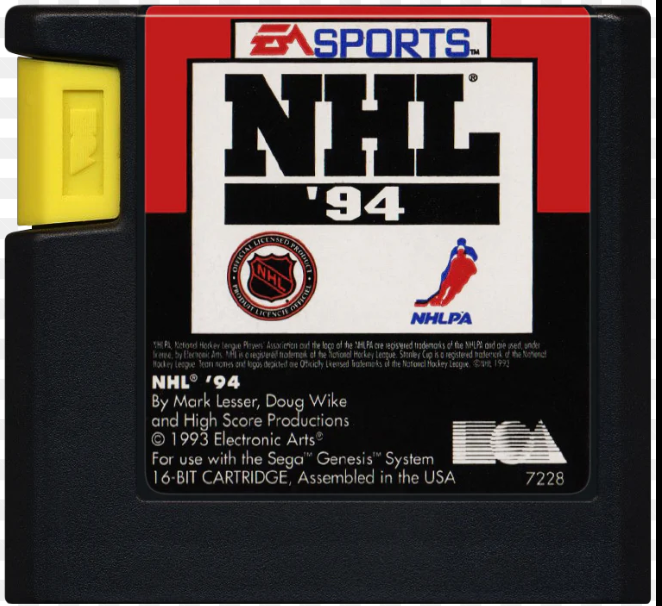
Of course he threatened the people at Sega of America that he would flood the Genesis market with waves of unlicensed EA games if they didn't give EA favorable royalties. Which meant that EA was also getting a larger cut of the profits for every EA cart sole on the Genesis/ MD in comparison to Nintendo's 30% cut. EA was allowed to manufacture their own taller yellow tabbed carts , which also saved on manufacturing costs too.

Nintendo had to change their contracts with the SNES to allow publishers to make multi-platform games. At this point EA became a publisher. But they still favored the Genesis over the SNES. EA published over 120+ games on the Genesis/ MD overall.

, but the Genesis version was invariably better in everything except resolution and color palette, every single time.
That's not true at all. Every EA sports game on the Genesis runs at a higher resolution than their SNES games. The typical Genesis game has a resolution of 320x224, while the typical SNES game displays at 256x224. There are very few cases where a Genesis game runs at 256x224. The only real upsides to the SNES versions were the higher colour pallets and sometimes the PCM audio channels that allowed for clearer voice samples.

EA really struggled with their earlier SNES ports of Madden, NHL and the NBA games... as they did suffer from slow down, limited field of view (lower resolution on the SNES). The SNES versions would honestly lack digitized voices, manly because the SNES cart had to use the extra space to store audio fonts for the music, while the Genesis game used FM Synth via EA's custom audio driver. The SNES ports would also lack various player tracking features and other modes from the SNES games, making them generally inferior. EA really didn't get their shit together with the SNES ports util much later in the consoles life cycle.


The SNES was simply never the preferred system for devs of sports and racing games, and this absolutely influenced the fate of Nintendo systems down the line.

Sega always had the monopoly on sports games during the 16bit era. Everything from Tommy Lasorda baseball, Joe Montana, The EA games and Sega's own World Series Baseball franchise. World Series Baseball became the definitive 16bit baseball game series.

The Super Nintendo also had good sports games as well... but most were less sim-like and more arcade-y (oddly enough). Konami did make some good Soccer games for the system. I would say the Genesis dominated the sales charts in sports games between 1990 to 1994 or 1995...I don't believe there was ever a time when Nintendo's SNES beat out the Genesis in sports games sales in any consecutive year (but I could be proven wrong).

By the time the Playstation ad Saturn came out, there was a huge shift over to those systems for the major sports franchises. The N64 didn't do too bad, with its four control ports and fast loading games.
 
Here is hardware data for 1993 from this report (https://archive.gamehistory.org/item/154132c1-ac50-4a98-be46-ac3d29a17f23).

1993 US Hardware Sales:

  1. [GEN] 34.1%
  2. [SNES] 25.3%
  3. [GB] 22.4%
  4. [GG] 10.5%
  5. [NES] 5.5%
  6. [SCD] 2.2%

1993 Monthly US Hardware Sales:

ConsoleJANFEBMARAPRMAY-SEPOCTNOVDEC
GEN35.5%33.4%26.9%28.9%28.4%-28.9%35.9%36.6%37.8%
SNES34.2%31.4%29.7%28.4%24.6%-32.2%27.9%21.6%22.6%
GB13.3%16.4%28.0%26.2%29.3%-24.4%20.8%22.2%19.8%
GG5.4%6.4%5.3%7.1%8.5%-7.7%9.1%12.6%12.5%
NES9.0%9.9%8.2%7.0%6.5%-5.3%4.5%4.8%4.2%
SCD2.6%2.4%2.0%2.4%2.8%-1.5%1.7%2.2%3.1%


I assume 1993 was the peak of Sega brand relevance.
Sega was really big during the holidays.
Game Boy had a large lead over Game Gear but Game Gear was not that ridiculous either.
NES was the old platform still having legs like PS1 in early 2000s or PS2 in late 2000s.
Sega CD was really a waste of resources.
 
'Sega's extensive library of software, including blockbuster titles each selling over one million units in 1993,
contributes to the continued success of Genesis. Last year's hit titles include games based on original Sega
characters such as "Sonic Spinball," great sports games such as "NFL Football '94 Starring Joe Montana,"
number-one selling comic book favorite "Marvel Comic's X-Men," and movie-based titles, "Disney's Aladdin"
and "Jurassic Park" expand on the success of the year's biggest blockbusters." - https://web.archive.org/web/2011100....php?99947-Sega-of-America-in-the-early-1990s

So it's likely the top 9 all sold over 1 million:

1.) Mortal Kombat - 777,200
2.) X-Men - 479,300
3.) Aladdin - 378,400
4.) Jurassic Park - 351,000
5.) Sonic Spinball - 318,700
6.) Street Fighter II': Special Champion Edition - 317,700
7.) Madden NFL 94 - 317,400
8.) NHLPA 94 - 256,400
9.) Joe Montana 94 - 215,200
 
8.) NHLPA 94 - 256,400

You're doing great with the sales number tracking. But my OCD just can't get over the NHLPA 94 error.

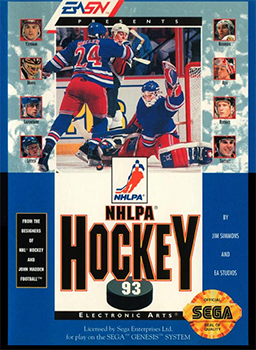
NHLPA '93 only has the player association license, and it does not have the actual NHL branding (they are two separate licenses). So it has no official team names of stadiums. Apparently the NHL pulled their license at the last minute because the game has fighting and blood in the game.

It's the only EA hockey game where you can make Wayne Gretzky's head bleed. Also NHLPA '93 lacks the official NHL rule book of the 1992 season. So the game plays more like minor league hockey with NHLPA players.


I honestly kind of love NHLPA '93 because of this. It's still my favorite of the classic NHL Genesis games.

In order for EA to get the NHL license they had to remove the fighting and the blood from NHL 94. Which is honestly one of the biggest downgrades from NHLPA '93 to NHL '94 if you ask me. The game was reduced to 'roughing' and shirt pulling. Even NHL 96 brought back the fighting. But it was toned down from EA Hockey and NHLPA '93. I like NHL 96 more than 94... so suck it (to those who say NHL 94 is the better game).

dLE6L48c4ccIJRT6.png
EcH1tHyg7kRAxDof.png
 
Last edited:
The 1991 EA Hockey game for Genesis was the best hockey game I had played for years.

FIFA, the original genesis version, was the best 16-bit FIFA by far. You could run away with the ref chasing you lol.
 
I could understand why SEGA was worried over 3DO given EA and also the Jaguar with really good specs coming in at sub £199 price point (well, that was the promise) but by early 1994 it was clear it wasn't going to be a real issue and the Sega Saturn would be ready and so all focus should have lead with that.

3DO was a legitimate stress point to have at the time, I'd agree. Not even so much because of EA, but Matsushita/Panasonic. They were a massive electronics company at the time and backing the system. Had they not priced 3DO the way they did, they could've easily taken Sony's place in the market before the PS1 released, tho whether they'd hold onto it long-term would depend on if they got the software support Sony eventually did.

Which, potentially would've happened in the West, thanks to EA's involvement, but less so in Japan. Matsushita didn't even have a game dev studio until 3DO when they started up Wondertainment, and most of their 3DO games weren't very good. Guess that would've made them equivalent to Sony Imagesoft, but the problem is even Sony moved on from Imagesoft when they purchased Psygonsis.

Matsushita/Panasonic would've needed to make a similar acquisition or strong partnership, but with a Japanese company. Maybe Hudson Soft, as they always seemed willing to support various platforms and had very skilled programmers. But I can't think of too many others besides maybe Namco, but that would've needed to happen way earlier in 1993, maybe even 1992, because by late 1993 Namco were basically on Team PlayStation.

I would have just gone with Saturn myself, but if price was such an issue, then the Jupiter would have been a better way IMO. I would guess SEGA picked the chips for a reason and maybe the SH1 couldn't handle all the tasks you list, since I think it also had to help deal with Mpeg decoding

Well, about the MPEG decoding, I think that would've ultimately been improved if SEGA went with a 1 MB BIOS with some RTOS libraries. I just learned of this, but they already had task distribution routines in kernels for the Model 1 & Model 2 boards for games like Daytona USA, and this is clearly before Saturn released. Sato and his team could've just adapted those into a 1 MB BIOS/lite-RTOS for Saturn for assisting task distribution between the SH2, among other things.

The SH1 was pretty powerful in its own right, and very overpowered for simply managing the CD-ROM drive. I think it'd have the overhead to take on tasks as the audio CPU and even the SCU DSP manager, too, with that 1 MB BIOS. And then with improved SCU DSP performance, you could move MPEG decoding off to that or the slave SH-2 if you wanted.

It's really frustrating to consider this is something SEGA could have realistically pushed for Saturn ahead of the launch, and also trim down silicon fat (i.e get rid of the 68000 CPU and support chips, simplify the motherboard etc.). Yes it would've been an insane amount of crunch for the hardware team but it would've been worth it long-term and IMO saved their console business long-term.

Like I'm not saying the Saturn would suddenly be super-cheap to manufacture or super-easy to program for, but the costs would've been reduced & manageable, and devs would've found it much easier to code on. Would've also boosted effective graphics performance thanks to improved synchronization throughout the system.

But, that didn't happen in our timeline unfortunately.

From what I remember, it was 1st meant to be a faster Mega Drive with just more colour. I would imagine SEGA wanted to counter the better specs of the SNES and counter the Super Grafx

Could've been the very early plans for it, yes.
 
3DO was a legitimate stress point to have at the time, I'd agree. Not even so much because of EA, but Matsushita/Panasonic. They were a massive electronics company at the time and backing the system. Had they not priced 3DO the way they did, they could've easily taken Sony's place in the market before the PS1 released, tho whether they'd hold onto it long-term would depend on if they got the software support Sony eventually did.

Which, potentially would've happened in the West, thanks to EA's involvement, but less so in Japan. Matsushita didn't even have a game dev studio until 3DO when they started up Wondertainment, and most of their 3DO games weren't very good. Guess that would've made them equivalent to Sony Imagesoft, but the problem is even Sony moved on from Imagesoft when they purchased Psygonsis.

Matsushita/Panasonic would've needed to make a similar acquisition or strong partnership, but with a Japanese company. Maybe Hudson Soft, as they always seemed willing to support various platforms and had very skilled programmers. But I can't think of too many others besides maybe Namco, but that would've needed to happen way earlier in 1993, maybe even 1992, because by late 1993 Namco were basically on Team PlayStation.


Well, about the MPEG decoding, I think that would've ultimately been improved if SEGA went with a 1 MB BIOS with some RTOS libraries. I just learned of this, but they already had task distribution routines in kernels for the Model 1 & Model 2 boards for games like Daytona USA, and this is clearly before Saturn released. Sato and his team could've just adapted those into a 1 MB BIOS/lite-RTOS for Saturn for assisting task distribution between the SH2, among other things.

The SH1 was pretty powerful in its own right, and very overpowered for simply managing the CD-ROM drive. I think it'd have the overhead to take on tasks as the audio CPU and even the SCU DSP manager, too, with that 1 MB BIOS. And then with improved SCU DSP performance, you could move MPEG decoding off to that or the slave SH-2 if you wanted.

It's really frustrating to consider this is something SEGA could have realistically pushed for Saturn ahead of the launch, and also trim down silicon fat (i.e get rid of the 68000 CPU and support chips, simplify the motherboard etc.). Yes it would've been an insane amount of crunch for the hardware team but it would've been worth it long-term and IMO saved their console business long-term.

Like I'm not saying the Saturn would suddenly be super-cheap to manufacture or super-easy to program for, but the costs would've been reduced & manageable, and devs would've found it much easier to code on. Would've also boosted effective graphics performance thanks to improved synchronization throughout the system.

But, that didn't happen in our timeline unfortunately.


Could've been the very early plans for it, yes.
It always surprised me at how well the 3DO sold in Japan, it did really good all things considered. I highly doubt SEGA putchips inside the Saturn for the fun of it. I would imagine every chip was picked for its price and the role it had to do and so never been one to say SEGA could have taken out that chip or put this one in.

All I would say is the development tools and the early development kits could and should have been better & cheaper. Plus with the benefits of hindsight from developers. SEGA should have doubled the sound RAM inside the Saturn and allowed each SH-2 to have its own RAM and not had a delay while the slave SH-2 was waiting for the main SH-2 to use RAM Ect Which was a bottleneck some of the better Saturn developers said could have been better and how the amazing Saturn sound chip was hurt with the lack of RAM and no hardware sound compression (like the PS1) sadly ADX came a little bit late to help with early Saturn games

Othwersise the Saturn was the best SEGA could make and afford at the time, I also would have kept the original silver champagne finish of the Saturn too and not gone with black or Grey
 
I got into Genesis later (~2003) as a kid and it was always a bummer that most of the cartridges you'd find at thrift stores or garage sales were these games. I'd be reading about all the awesome games online at Sega-16.com but didn't really have access to eBay, and meanwhile anytime you found Genesis stuff it would be more Sports games or the 10th copy of X-Men or Sonic 2 or whatever you'd seen that year. Makes sense when you see the sales numbers.

The really good games we talk about now were kinda obscure even at the time it seems, and probably played more by adult Genesis fans instead of kids (the main demographic). I imagine most people with Genesis back in the day didn't even know stuff like Ranger X or whatever even existed.
 
It always surprised me at how well the 3DO sold in Japan, it did really good all things considered. I highly doubt SEGA putchips inside the Saturn for the fun of it. I would imagine every chip was picked for its price and the role it had to do and so never been one to say SEGA could have taken out that chip or put this one in.

Nah, there are definitely some chips in Saturn that didn't need to be there. The 68000 is a prime example IMO; if Saturn had MegaDrive BC then the 68K would make sense, but the VDPs in Saturn aren't the same as the MegaDrive's, and well, Saturn has no MegaDrive BC. The role of the 68K could've more than easily been handled by the SH1 CPU, and SEGA could've consolidated those two buses into one.

In fact, I think Sony basically did that with the PS1; the CD-ROM and audio processing are handled on the same sub-bus in PS1, whereas on Saturn they're on two separate buses. That just increases the number of PCB traces and also the pinout count for the SCU, alongside support chips for the 68K, when the SH1 could've already handled those duties in addition to managing the CD-ROM drive.

Those changes for the SH1 would've also helped make the Saturn cheaper to manufacture both for Japan and America; they'd of been able to better adjust to Sony's $299 price at E3 if they had done so.

All I would say is the development tools and the early development kits could and should have been better & cheaper. Plus with the benefits of hindsight from developers. SEGA should have doubled the sound RAM inside the Saturn and allowed each SH-2 to have its own RAM and not had a delay while the slave SH-2 was waiting for the main SH-2 to use RAM Ect Which was a bottleneck some of the better Saturn developers said could have been better and how the amazing Saturn sound chip was hurt with the lack of RAM and no hardware sound compression (like the PS1) sadly ADX came a little bit late to help with early Saturn games

TBF, RAM was VERY expensive in 1994 so doubling the audio RAM would've driven the price up even higher for Saturn, and its early BOM was already close to $400 for the Japanese launch. That might be why they sold it for ~ $440 when it did come out there.

The better option for Saturn was to improve the BIOS and increase its size to 1 MB. Your point about the SH2s for example; with a better BIOS they could've made accesses to the main bus non-blocking and had tasks auto-delegated to a Master SH2 with other tasks automatically pushed to the Slave SH2 when the main SH2 was too busy. Giving each SH2 its own RAM would've probably made cache coherency harder and it'd of been more difficult for the SH2s to share data since that'd mean two buses using the SCU to pass data between the RAM pools of each SH2 (and adding further congestion to the SCU), on top of doing manual cache coherency management.

It would've just complicated the Saturn's design too much; no support for ADPCM was a bit of a sore spot for Saturn but I'd say the bigger problem was no form of hardware-based texture compression. PS1 had it with JPEG (inter-frame) via the MDEC; Saturn you needed to handle decompression in software on one of the two SH2s which was very taxing. Or you could've used the SCU DSP in theory, that's if you were able to figure out how to use it in the first place however.

Othwersise the Saturn was the best SEGA could make and afford at the time, I also would have kept the original silver champagne finish of the Saturn too and not gone with black or Grey

There's a lot of good hardware in Saturn and if SEGA had better foresight to integrate usage of that hardware ahead of launch (mainly with a more robust, multi-kernel RTOS BIOS, which some of their arcade games already utilized so they could've adapted their multi-processor kernels for Saturn), they would've had a system with unquestionably better 2D AND 3D than the PlayStation and even (mostly) better 3D than N64 (prior to devs using custom RSP microcode, at least). In terms of main processors, the SH2s, SH1, SCU, VDP1 & VDP2 alongside the Yamaha were enough. The 68K could've and should've been removed, and the CD-ROM & audio subsystems should've been merged into one.

Those changes would've been fantastic for Saturn and Sato's team were capable of doing it; they just didn't have the foresight to consider the implications of why, and IIRC SEGA's arcade teams and home console teams were somewhat isolated.
 
Nah, there are definitely some chips in Saturn that didn't need to be there. The 68000 is a prime example IMO; if Saturn had MegaDrive BC then the 68K would make sense, but the VDPs in Saturn aren't the same as the MegaDrive's, and well, Saturn has no MegaDrive BC. The role of the 68K could've more than easily been handled by the SH1 CPU, and SEGA could've consolidated those two buses into one.

In fact, I think Sony basically did that with the PS1; the CD-ROM and audio processing are handled on the same sub-bus in PS1, whereas on Saturn they're on two separate buses. That just increases the number of PCB traces and also the pinout count for the SCU, alongside support chips for the 68K, when the SH1 could've already handled those duties in addition to managing the CD-ROM drive.

Those changes for the SH1 would've also helped make the Saturn cheaper to manufacture both for Japan and America; they'd of been able to better adjust to Sony's $299 price at E3 if they had done so.
SEGA liked to add CPU's to their soundchips, even the DC. The PS1 wasn't meant to be £100 cheaper than the Saturn, that was a move made by SONY America, which really pissed off Sony Japan early in, but it worked out in the end.

TBF, RAM was VERY expensive in 1994 so doubling the audio RAM would've driven the price up even higher for Saturn

I know it was, but that would have made a world of difference IMO for what was one of the most powerful chip inside the Saturn. Sadly, ADX came just a little late in the Saturn life to really make a difference and show how much better the Saturn sound chip was compared to the PS1 sound chip.

There's a lot of good hardware in Saturn and if SEGA had better foresight to integrate usage of that hardware ahead of launch

At end of the day what cost and hurt the Saturn the most IMO was leak marketshare in the West, that meant many developers didn't put the time or effort into making full use of the system, I blame the 32X for that more than Saturn hardware shortcomings. The only issue I really had with my years of the Saturn was the lack of 3D transparent polygon effects, which stook out like a sore thumb even up against the 3DO, never mind the PS1

That again seemed like a SEGA issue, be that with the Mega Drive vs the SNES for transparency, even Model 1 or Model 2 had to make use of the mesh effect for their 3D transparent effects
 
SEGA liked to add CPU's to their soundchips, even the DC. The PS1 wasn't meant to be £100 cheaper than the Saturn, that was a move made by SONY America, which really pissed off Sony Japan early in, but it worked out in the end.

Don't know much about the $299 pricing being a Sony of America thing and pissing off Sony of Japan; there may be truth to it, but this is my first time hearing of that. Though, considering the PS1's Japanese price was equivalent to ~ $349 - $399 adjusted for USD at the time, I figure there could in fact be truth to assuming Sony Japan had issues with the US $299 price. Might be a reason Steve Race retired shortly afterwards ahead of the US launch?

But back to the sound chip stuff...I'm not saying the Saturn shouldn't have had a sound CPU, just that the SH1 could've been the sound CPU/manager instead of the 68K. And in doing so, would've saved costs on the Saturn's BOM. Because one thing I know for sure is that PS1's BOM was a lot cheaper than Saturn's, and it's the high BOM that eventually really hurt SEGA in America & Europe when Sony decided on their $299 pricing.

I know it was, but that would have made a world of difference IMO for what was one of the most powerful chip inside the Saturn. Sadly, ADX came just a little late in the Saturn life to really make a difference and show how much better the Saturn sound chip was compared to the PS1 sound chip.

Maybe, but it'd of just been a bragging point to win some gamer cred, it wouldn't have translated into massively boosting Saturn sales, which is what SEGA actually needed to happen. 512 KB audio RAM was plenty for that gen; making the audio subsystem work more efficiently is what would've been the gamechanger IMO.

That's why I've been going so hard on this RTOS BIOS supporting auto-task distribution, virtual cache coherency, A-bus interrupt handling (for the cartridges) etc. At the very least SEGA could've designed the SCU with address remapping on the memory controller to support boot from an external enhanced BIOS cartridge after launch. The level of performance upgrade Saturn could've gotten from such a BIOS is actually quite insane (and would've made dev lives a lot easier).

At end of the day what cost and hurt the Saturn the most IMO was leak marketshare in the West, that meant many developers didn't put the time or effort into making full use of the system, I blame the 32X for that more than Saturn hardware shortcomings. The only issue I really had with my years of the Saturn was the lack of 3D transparent polygon effects, which stook out like a sore thumb even up against the 3DO, never mind the PS1

32X definitely played a part in Saturn's problems in the West, but if the Saturn were an easier console to work with, devs would've washed away the 32X aftertaste, got to work on impressive Saturn games, and get its market share up.

If SEGA didn't do the surprise May launch pissing off many major retailers (who then refused to carry Saturn as a result), they would've had the required distribution network in place to reach more people who'd buy Saturn consoles. So I can't blame 32X for the majority of Saturn's failures; most of those land squarely on Saturn itself and how SEGA handled the system.

That again seemed like a SEGA issue, be that with the Mega Drive vs the SNES for transparency, even Model 1 or Model 2 had to make use of the mesh effect for their 3D transparent effects

SEGA probably took that approach to transparency because CRTS of the era did enough natural "blending" of rough pixels to fake transparency when you combined it with dithering, and dithering was less processor-intensive, memory-intensive and bandwidth-intensive.

The illusion of "fake" transparencies only fell apart when you viewed games on those systems on non-CRT monitors of the era.
 
Don't know much about the $299 pricing being a Sony of America thing and pissing off Sony of Japan; there may be truth to it, but this is my first time hearing of that. Though, considering the PS1's Japanese price was equivalent to ~ $349 - $399 adjusted for USD at the time, I figure there could in fact be truth to assuming Sony Japan had issues with the US $299 price. Might be a reason Steve Race retired shortly afterwards ahead of the US launch?
Yep, SONY Japan wasn't happy with the price of the PS1 in the USA or Europe or their big spends on various PS promtions. So that's why just before the launch of the PS1 you have SONY Canada closed, people like Steve Race, Clyde Grossman gone and a massive restructuring in SOA. All that politics over costs and pricing is one of the reasons why Olafur Olafsson was pushed out later too

But back to the sound chip stuff...I'm not saying the Saturn shouldn't have had a sound CPU, just that the SH1 could've been the sound CPU/manager instead of the 68

I remember on the last few years of Dreamcast Technical Pages, some people saying the DC didn't need an ARM sound CPU or the DC should have had twin SH-4's. In the end, none of us is on a board that draws up and develops console boards. I just go on what was in the final product, and that the likes of SEGA chose each chip for a reason for the tasks they wanted and what they could afford.

It was just a shame that while having a vastly superior sound chip, you didn't always hear it in 3rd party ports and sometimes the Saturn game sounded worse, thanks to issues over the sound ram. I would have liked to have seen the RAM doubled. Yes, that adds to the cost, but in those days, Ram usually tended to come down in price after a while.


If SEGA didn't do the surprise May launch pissing off many major retailers (who then refused to carry Saturn as a result), they would've had the required distribution network in place to reach more people who'd buy Saturn consoles. So I can't blame 32X for the majority of Saturn's failures; most of those land squarely on Saturn itself and how SEGA handled the system.
To me, that's just more excuses.

I'll be the biggest hypocrite to go against an early launch as the reason I first started importing in 1991 was I was sick of the long waits from Japan to Pal and I also don't belive was one second the early launch was call made in Japan either, it was instead a desprate move made by SOA after a poor 2nd wave of 32X software and sales. When i-Phone 1st launched in the UK, it was only available on one carrier that didn't stop it from selling like hotcakes.

You compare the titles for the GameCube and Dreamcast Western launches, the price of their consoles vs the launch price of the PS2 or and they were far easier to work on too and yet the PS2 killed them both for sales from the go. So it's just always excuses with the Saturn. My only issue with the early launch on the Saturn was the date. It would have been better to go in late July, early Aug when the likes of Bug, ClockworkKnight 2, not that would have made much difference.

The real issue was SOA had nothing much ready for Saturn and was so utterly convinced that the 32X would sell better than any next-gen system, that they really didn't have to do much early in for the Saturn.

SEGA probably took that approach to transparency
It was a SEGA issue both in their Arcade and console boards, even the 3DO killed the Saturn for 3D transparent effects, the Saturn version of Starfighter looks utterly dreadful next to the 3DO version souly thanks to the use of mech effects, and that was the case of many Saturn port,s even if they were close ports, like Tunnel B1

It was my only disappointment with Saturn
 
Last edited:
Top Bottom